The body's own cannabinoid system
The ECS and the entourage effect
Components of the endocannabinoid system have been demonstrated in various animal species, including mammals and birds. This makes possible interactions biologically conceivable, but does not prove that the entourage effect has been demonstrated in every species.
The endocannabinoid system
A network throughout the body
The endocannabinoid system, usually abbreviated to ECS, consists of the body's own signaling substances, receptors and enzymes.
CB1 receptors are common in the brain and central nervous system. CB2 receptors are mainly associated with the immune system and various peripheral tissues. The distribution is not black and white: both receptor types occur in several places in the body.
CBD does not simply act like a key that turns on one cannabinoid receptor. It can influence the broader system through various pathways and receptors.
Unique explanation illustrations
CB1 and CB2 in dogs

Important areas in the brain
- Brain cortexMemory, thinking and perception
- HypothalamusIncluding appetite and metabolism
- AmygdalaEmotional processing
- Basal gangliaMovement and learning
- CerebellumCoordination and muscle control
- BrainstemVarious vital body functions
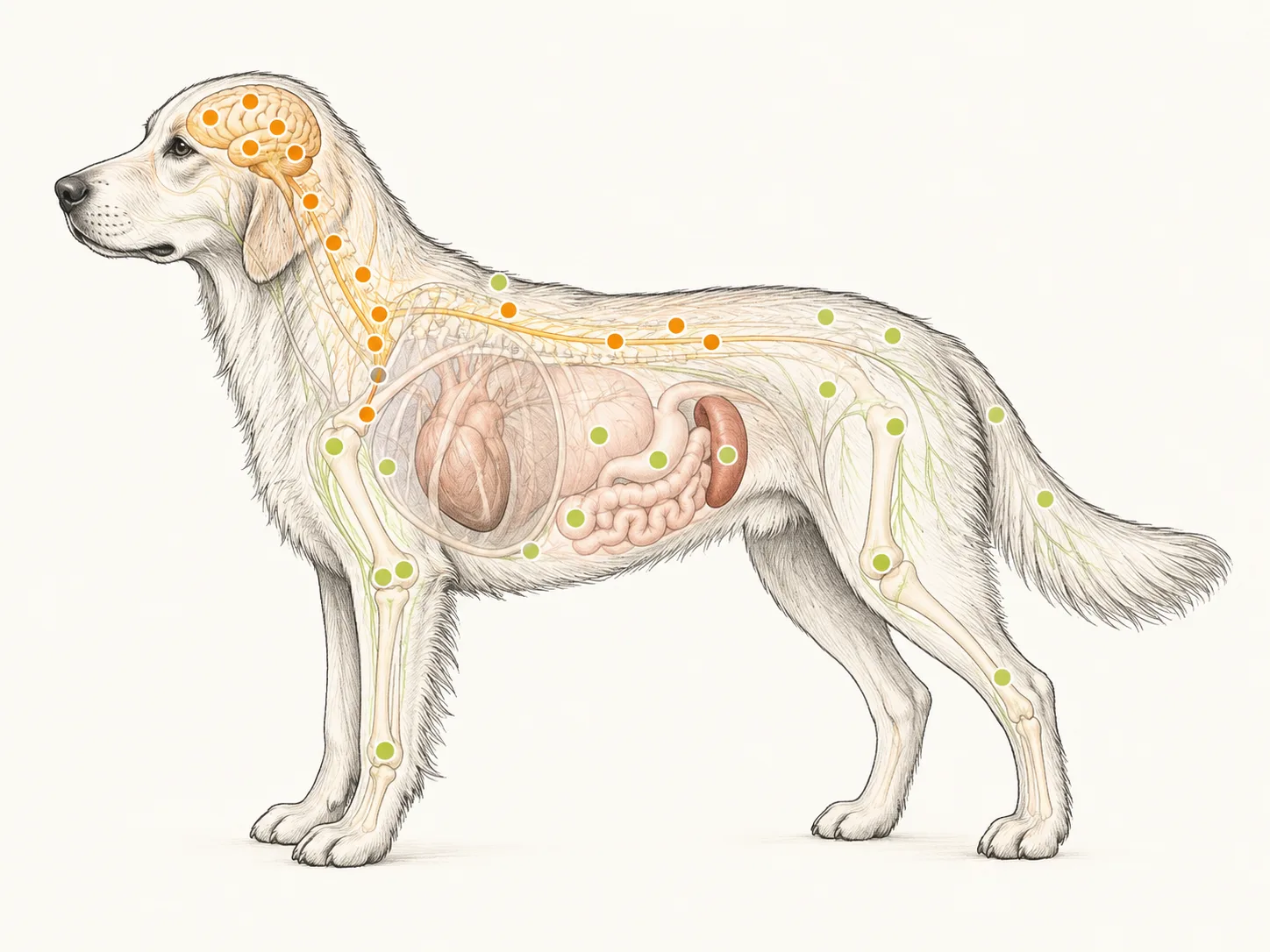
Receptors throughout the body
CB1 is relatively common in the brain and central nervous system.
CB2 is mainly associated with the immune system and peripheral tissues.
The distribution is not absolute: both receptor types can occur in multiple places.
Composition of the oil
What does entourage effect mean?
The entourage effect refers to the possible collaboration between CBD, other cannabinoids, terpenes and other components of the hemp plant.
The basic principle is that a combination of components can have a different overall profile than completely isolated CBD. Gold therefore contains 100% full-spectrum hemp extract in hemp seed oil. CBD isolate is highly purified cannabidiol with a narrower profile than full-spectrum hemp extract. The complete formulation determines which other components a product contains.
The entourage effect is therefore mainly a concept about cooperation within the formula. It is not the same as the amount of CBD that enters the bloodstream from the intestines.
View the composition of Gold CBD →By animal species
Biologically possible is not the same as proven
Relatively the most researched
The ECS and CBD products have been studied more in dogs than in many other pets. A separate clinical entourage effect has not been convincingly proven in dogs either.
Less research data
Cats have an ECS, but species-specific evidence for the entourage effect is lacking. Their metabolism and product composition require separate attention.
Not one animal group
Much basic knowledge comes from research with laboratory rodents. That knowledge does not prove an entourage effect in every rabbit, guinea pig or hamster.
ECS present, evidence very limited
Cannabinoid receptors have also been demonstrated in birds. However, the entourage effect has not been convincingly studied in pet birds.
Our conclusion: it is irresponsible to write that the entourage effect has been proven to apply to all animals. We consistently talk about a possible interaction within full-spectrum hemp extract and identify the limitations of the research per animal species.
Bioavailability
Intake is mainly about nutrition and fats
CBD is fat soluble. A small bite of suitable, fat-containing food helps CBD pass through the digestive system and can support bioavailability. This nutritional effect is separate from the entourage effect, but both topics are relevant to the ultimate use of a CBD oil.
- Entourage effect: possible cooperation between constituents.
- Bioavailability: which part of the CBD reaches the body.
- Practical advice: preferably serve the oil with a small snack containing fat.
Substantiation
What is this explanation based on?
Comparative veterinary research describes the ECS and cannabinoid receptors in different animal species. Regarding the entourage effect itself, recent overview studies conclude that the available results are limited, contradictory and not yet convincing.